Silicosis Support Hub – Integrating Action, Risk Awareness and Support in a National Health Crisis

good-design-award_winner_rgb_blk_logo
  • 2026

  • Social Impact

Designed By:

Designed In:

Australia

The Silicosis Support Hub helps workers, families and professionals navigate fragmented screening, medical, legal, compensation and support systems in Australia’s growing silicosis crisis. Co-designed with leading experts and people with lived experience, it transforms fear and uncertainty into informed action — now embedded in government, regulatory and professional infrastructures nationally.

view website

2.jpg
3.jpg
4.jpg
5.jpg
  • CHALLENGE
  • SOLUTION
  • IMPACT
  • MORE
  • Australia faces a serious, accelerating silicosis crisis - with over 600,000 workers exposed to silica dust in construction, tunnelling, mining and other industries.The challenge was not simply to create information - it was to address a coordination failure. Five systems (screening, medical care, legal pathways, compensation and psychosocial support) operate with siloed information and rare connections. Workers lose early care opportunities and entitlements, while fear, anxiety and distress become barriers to engaging with the services that could help.The solution had to be clinically and legally accurate, jurisdictionally-specific, accessible across literacy levels and languages, and trusted by workers, families and professionals.

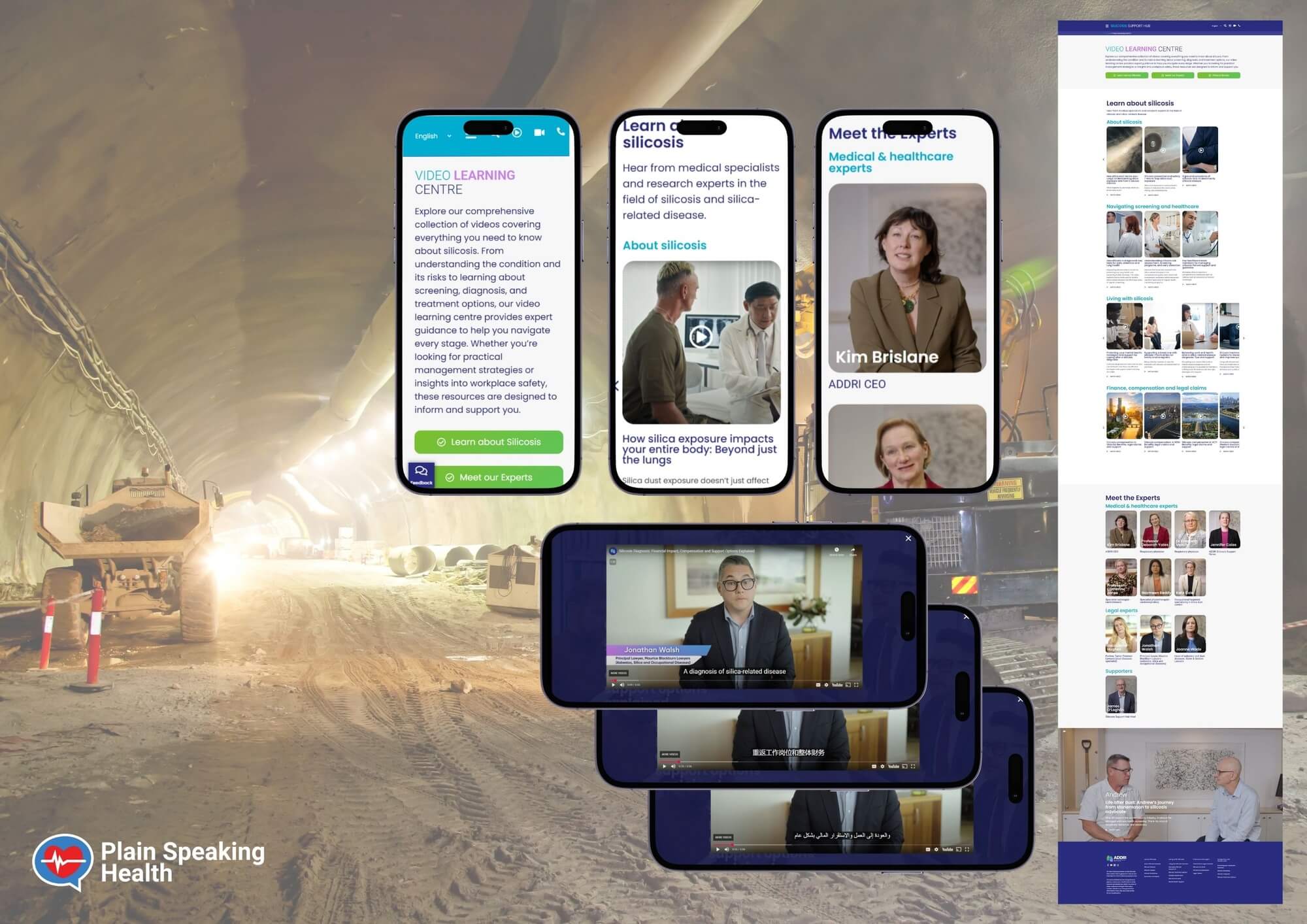
  • Plain Speaking Health designed the Hub as a coordinated navigation system, not a content library. The key design decision: build the architecture around where a person is in their silicosis journey, not around institutional categories.Collaborative curriculum design defined scope across system domains. Population-level search data revealed real knowledge gaps, shaping content and architecture. The result was the Learn, Take Action, Connect framework — with plain-language content validated by medical, legal and compensation experts, multilingual subtitled videos (short and long-form), state-specific action guides, and Risk Assessment Tool with GP-ready report. Every element designed to reduce distress and support informed action.

  • In its first year, the Silicosis Support Hub reached 10,623 unique users across every Australian state, generating 756,000 Google Search impressions, a 60% engagement rate, and over 10,000 video views. The Risk Assessment Tool is providing preliminary insight into a critical epidemiological gap — suggesting substantial numbers of workers may be at high risk. Government agencies, compensation authorities, peak health bodies, unions and major law firms have independently embedded the Hub into their own infrastructure, confirming its role in Australia's occupational health response. A grant application is underway to extend the Tool into a national screening resource and inform epidemiological research.

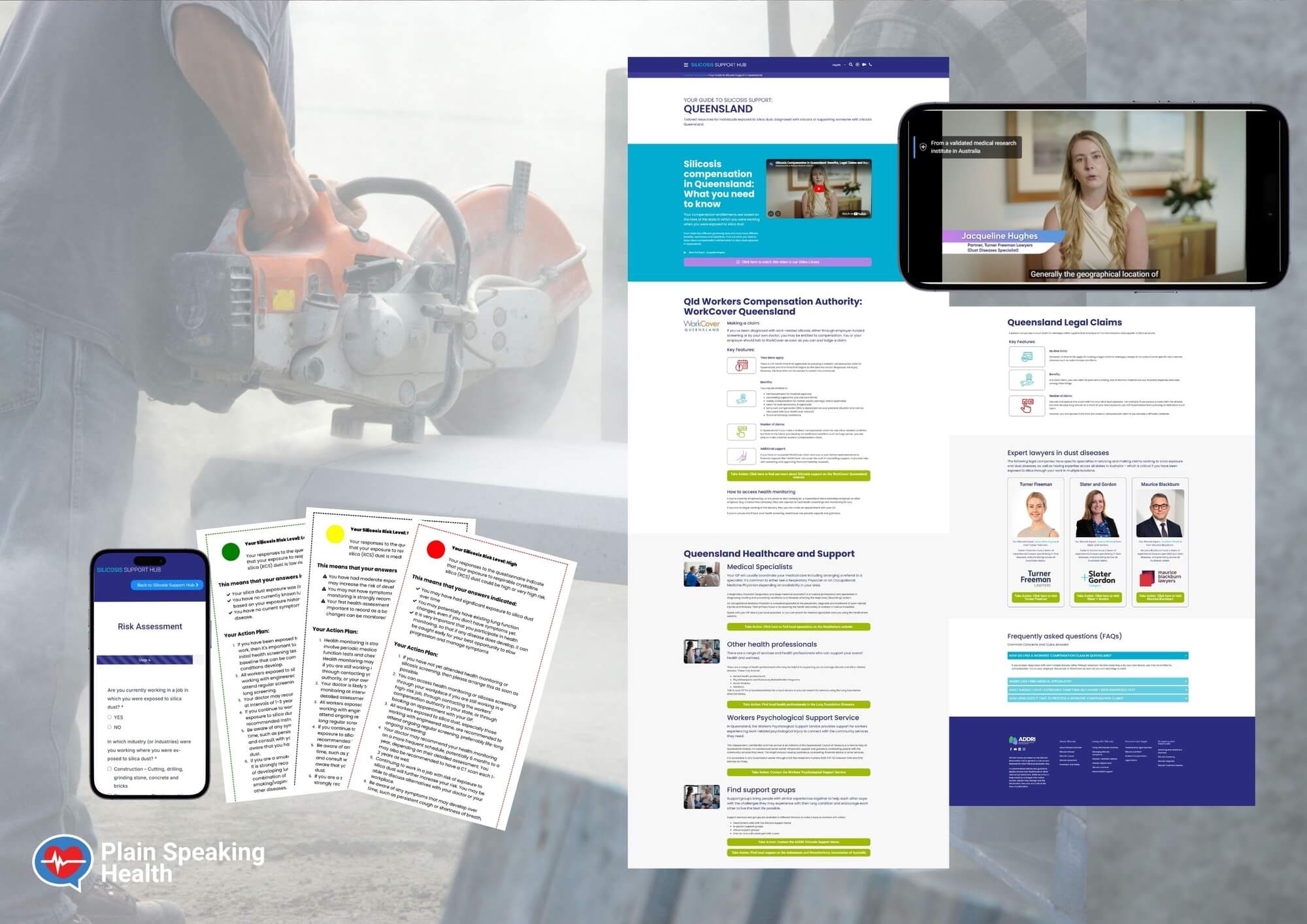
  • The Hub is structured around three pathways — Learn, Take Action, Connect — each mapped to distinct stages of the silicosis journey and connecting users to the relevant system domain.State-specific action guides navigate users through jurisdiction-relevant screening, compensation and legal processes — addressing one of the most significant barriers workers face: the complexity and variation of entitlements across states.All content is written to health literacy standards and validated by leading medical, legal and compensation experts. Short and long-form video content is professionally produced with subtitled (multilingual) — designed for users with varying literacy, language backgrounds and emotional capacity.The Silicosis Risk Assessment Tool generates a personalised risk output based on clinical criteria, with a plain-language action plan and GP-ready downloadable report. It bridges self-identification and clinical action — and is providing preliminary insight into the scale of silicosis risk across the Australian workforce.A direct pathway to ADDRI's Silicosis Support Nurse provides human connection for people who need guidance beyond digital navigation.Every element is designed not just to inform, but to move people from fear toward action — and from isolation toward support.