Mapping the Experiences of Victim-Survivors to Transform Family Violence Services

good-design-award_winner_rgb_blk_logo
  • 2026

  • Social Impact

Designed By:

Commissioned By:

SAFV

Designed In:

Australia

Paper Giant partnered with The Sexual Assault and Family Violence Centre (SAFV) to understand client experiences. Through trauma-informed research with 14 victim-survivors, we co-created client journey maps, six evidence-based personas, and an original intersectionality profile tool — giving SAFV the foundation to redesign services around the people they support.

view website

2.jpg
Paper Giant
3.jpg
Paper Giant
4.jpg
Paper Giant
5.jpg
Paper Giant
  • CHALLENGE
  • SOLUTION
  • IMPACT
  • MORE
  • The Sexual Assault and Family Violence Centre supports thousands of victim-survivors across the Barwon and Wimmera regions of Victoria. But SAFV's understanding of client experience was shaped primarily by staff perspectives and system-level data — not by clients themselves.SAFV needed to understand how clients actually experience their services: what builds or breaks trust, what creates barriers, and how intersecting identities — race, gender, disability, sexuality, age, class — shape each person's journey. The challenge was to conduct this research safely with people who have experienced significant trauma, while producing tools the organisation could use long after the project ended.

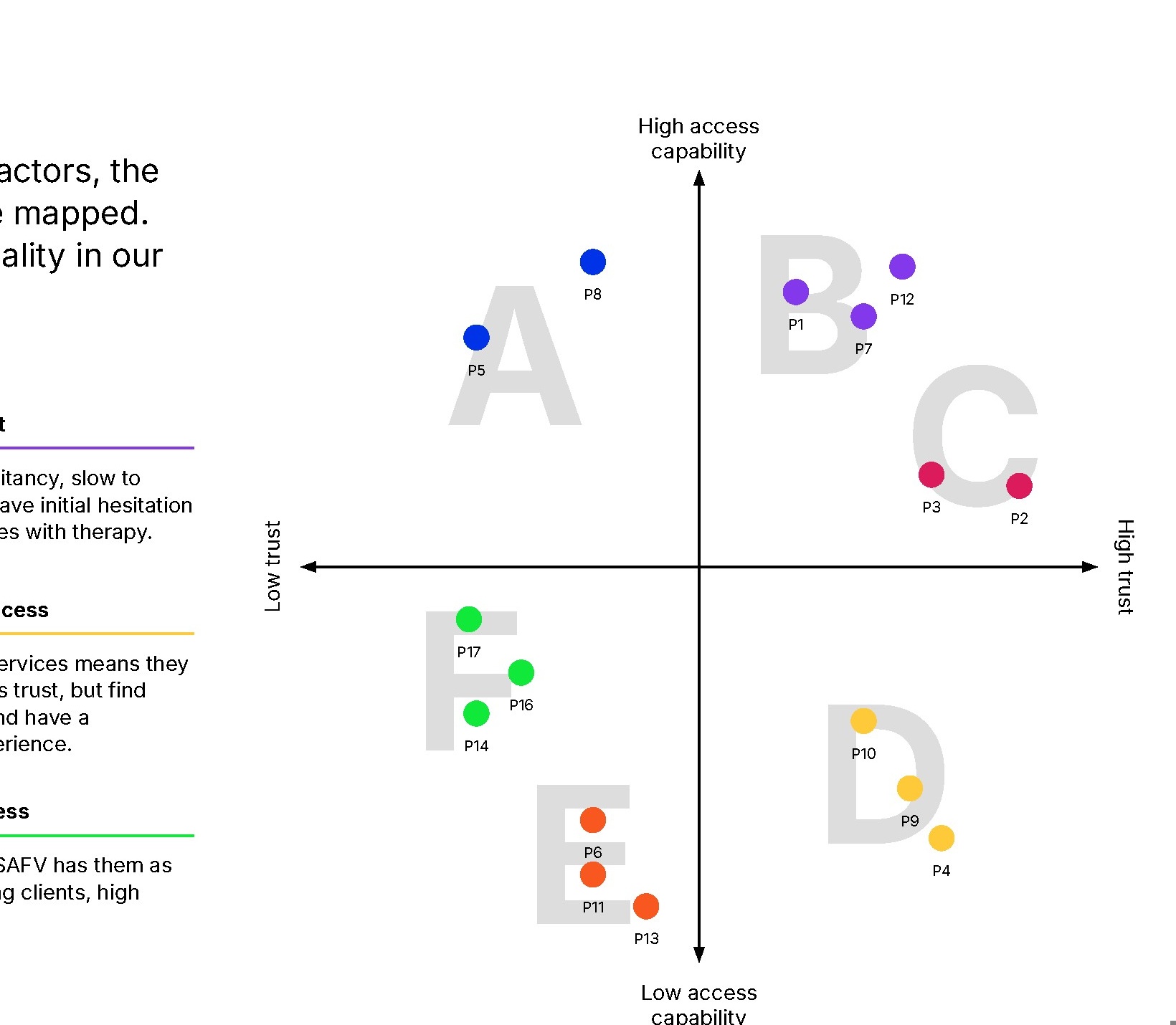
  • Paper Giant designed a trauma-informed research methodology centring client voices. We conducted 14 semi-structured interviews with past and current clients and two partner organisation interviews, followed by validation workshops where clients co-created the design outcomes.We collaborated closely with SAFV staff to ensure every interaction upheld high ethical standards and trauma-informed practice. The research identified two defining experience factors — speed to establish trust and level of access capability — that stratified clients into six distinct persona segments, combined with an original intersectionality profile tool to capture the compound nature of identity and disadvantage.

  • The project delivered three interconnected tools. Six client personas give SAFV staff an evidence-based understanding of diverse client experiences. A co-created journey map identifies pain points and opportunities across the full service experience. And an intersectionality profile tool provides a visual language for how overlapping identities create unique barriers.Together, these tools equip SAFV to make service design decisions informed by client experience rather than institutional assumptions. The intersectionality tool is reusable — staff can build new profiles as their client base evolves, and the methodology transfers to any service working with structurally disadvantaged populations.

  • Trauma-informed research methodology: Every aspect of the research was designed to prioritise participant safety and agency. Interview guides, consent processes, and facilitation approaches were developed in close collaboration with SAFV staff to ensure interactions were appropriate for people who have experienced sexual assault and family violence. The research team maintained trauma-informed practice throughout — creating psychological safety, respecting boundaries, and avoiding re-traumatisation.Intersectionality profile tool: An original design tool that uses overlapping geometric shapes to represent the compound nature of identity. Each shape represents an identity factor (race, gender, disability, sexuality, age, class, family structure, locality). Shape size indicates importance; overlap shows how factors interact. The tool comes with an interactive builder so SAFV staff can create new profiles independently.Co-created with clients: Personas and journey maps were not produced behind closed doors — they were validated and refined through workshops with the same clients who participated in research, ensuring the tools authentically represent lived experience.Six personas spanning the full client spectrum: From high-access, low-trust family violence survivors to men and trans people unsure the service is for them — the personas capture experiences typically invisible to service providers, including LGBTIQ+ clients, Aboriginal communities, CALD communities, and regional Victorians.