UNSW Academic Success Monitor

good-design-award_gold-winner_rgb_blk_logo
  • 2026

  • Service
    Education Services

Designed By:

Commissioned By:

UNSW

Designed In:

Australia

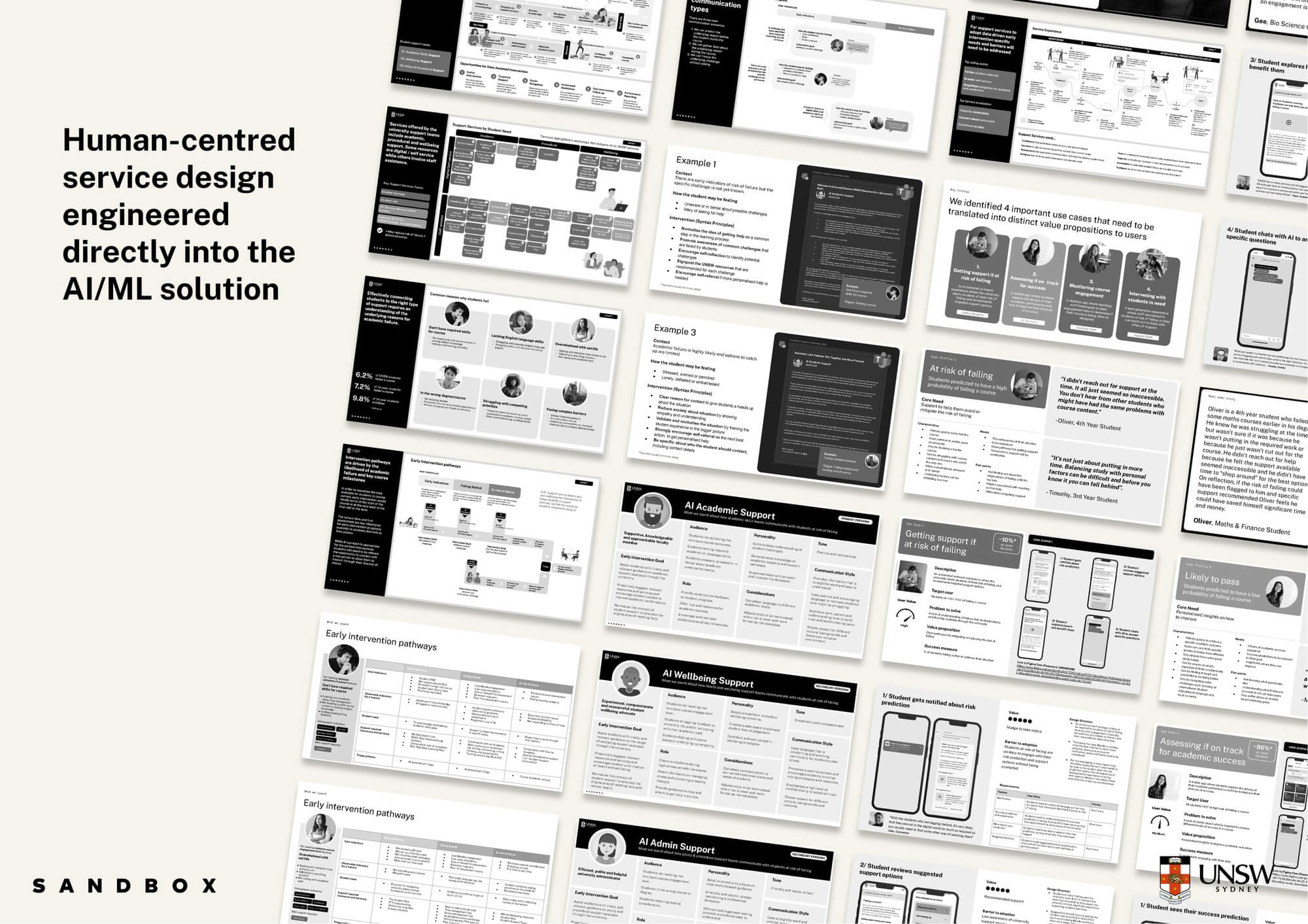
The Academic Success Monitor (ASM) combines predictive analytics, AI outreach and human expertise to transform student support from reactive case management to proactive intervention at scale. Developed by UNSW with service design support from Sandbox, it identifies students at risk of academic failure and connects them with the right support.


view website

2.jpg
3.jpg
4.jpg
5.jpg
6.jpg
7.jpg
8.jpg
9.jpg
  • CHALLENGE
  • SOLUTION
  • IMPACT
  • MORE
  • Academic failure is not caused by a single factor; it arises from complex combinations of academic, behavioural and organisational elements that make early intervention with students difficult. UNSW had demonstrated that its predictive model could accurately flag students at risk of failure, but a predictive signal is not a service.The challenge was to design a scalable service that could interpret multiple indicators of academic risk, determine appropriate student interventions, coordinate a complex network of university staff and support services, and balance automation with human judgement to ensure students feel supported rather than surveilled.

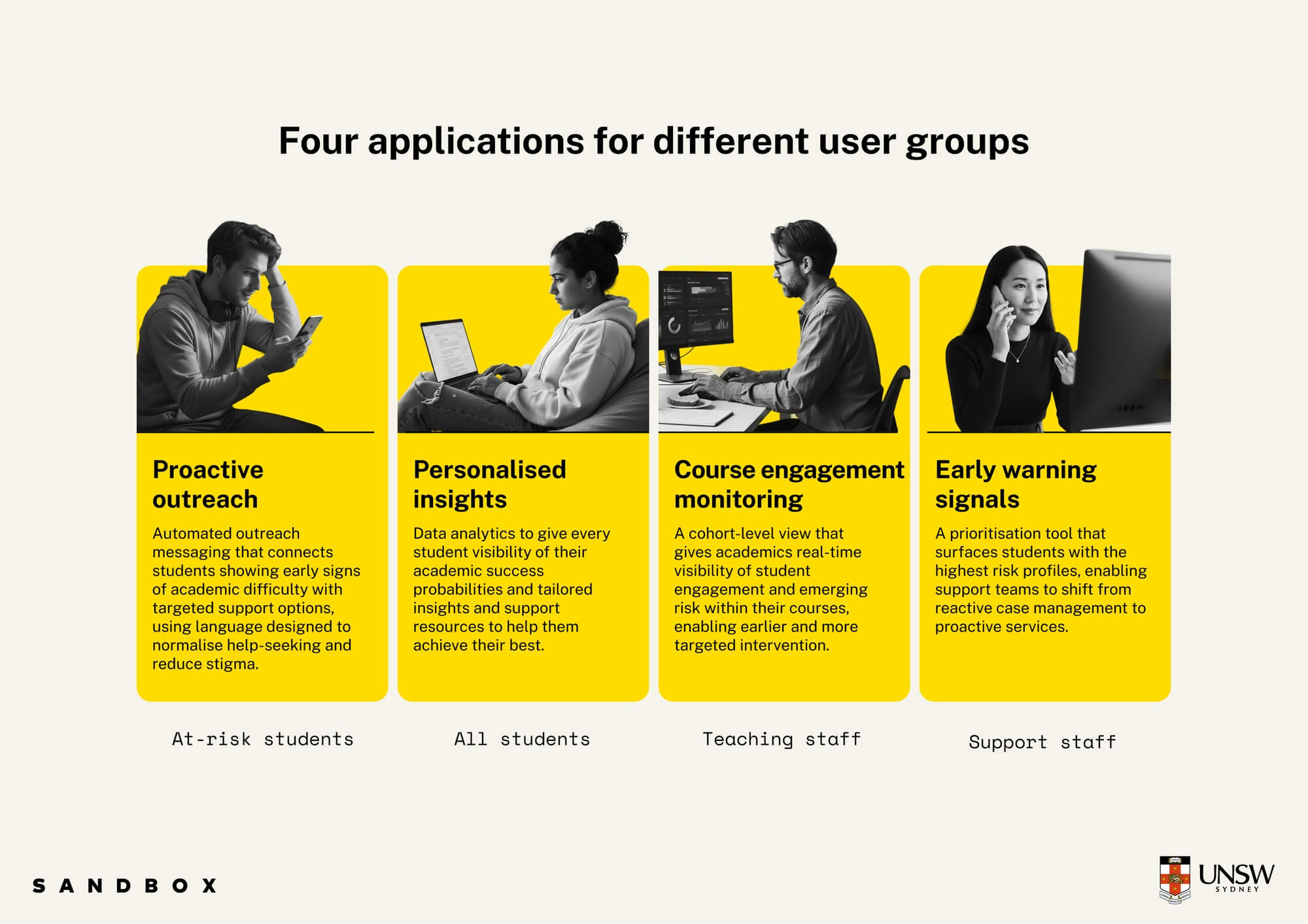
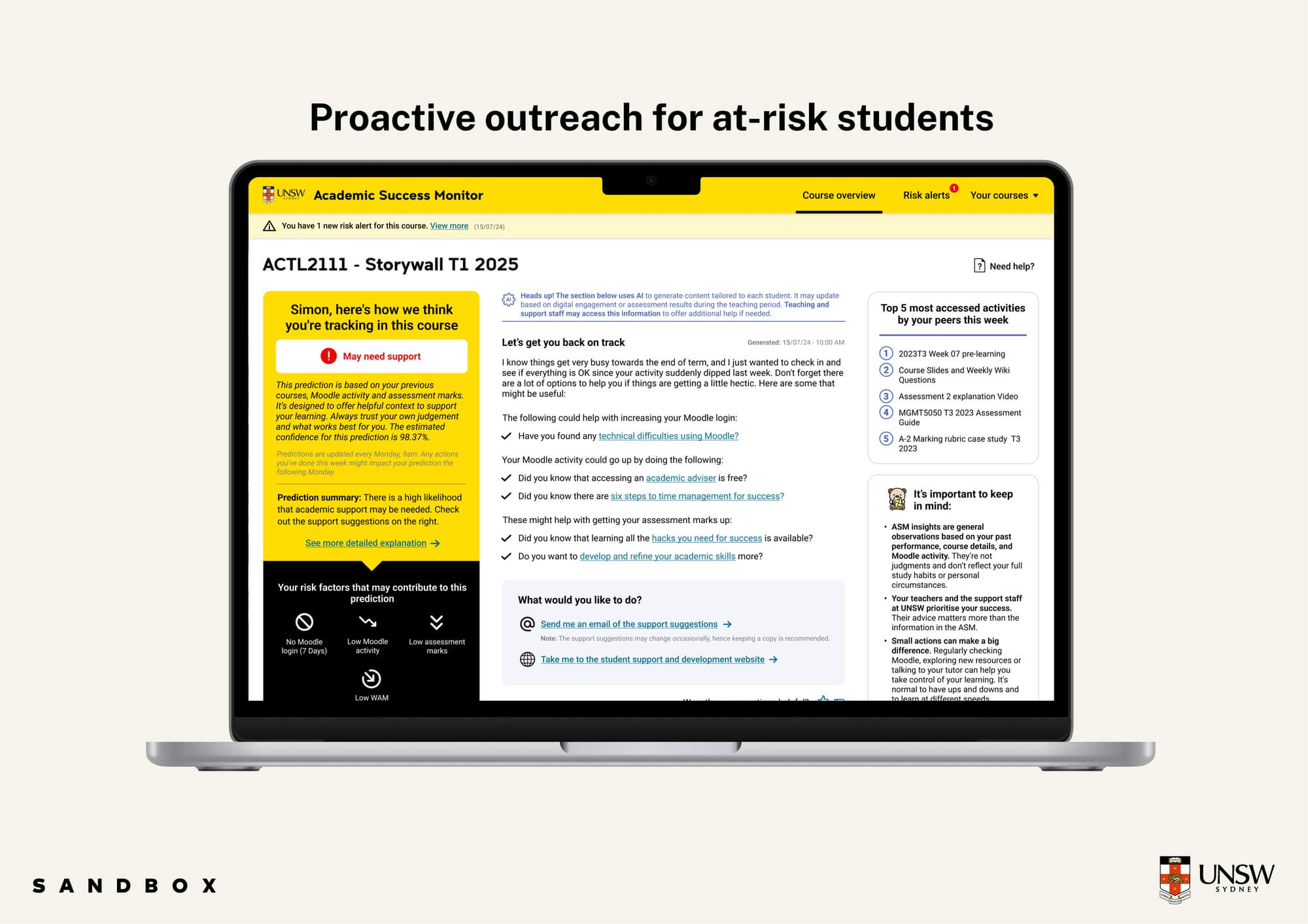
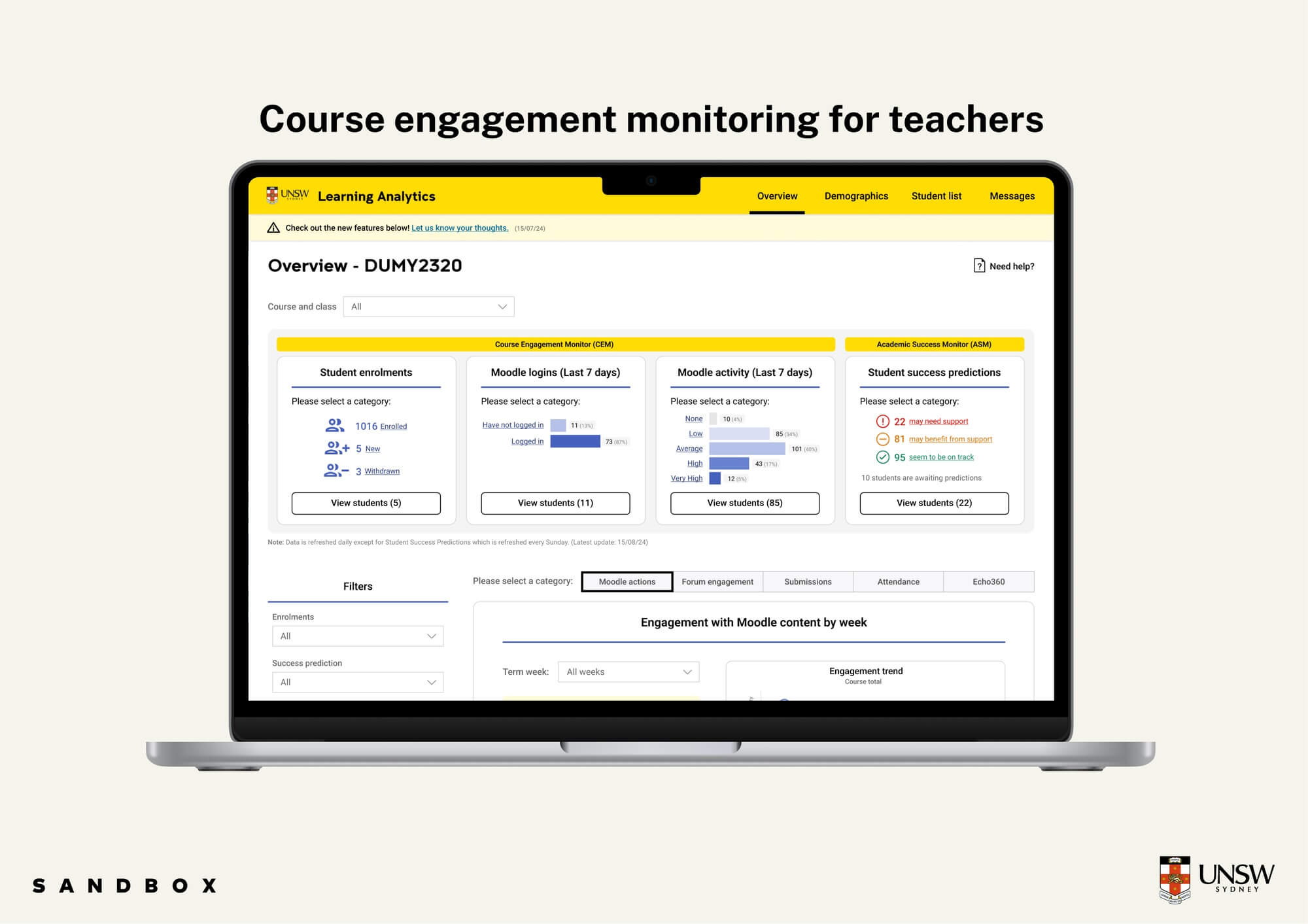
  • The solution design has two key layers: the intelligence that drives the AI's behaviour, and the experience that makes it valuable to users.At the intelligence layer; an intervention logic guides how the AI interprets risk and supports students. Co-designed with support staff, these rules define the triggers, risk thresholds, support pathways and communication style of the AI interventions. At the experience layer; four different applications put predictive intelligence in the hands of different user groups. Every student gets personalised insights; at-risk students receive proactive outreach; teachers get visibility of course engagement; and support teams can spot vulnerable students earlier.

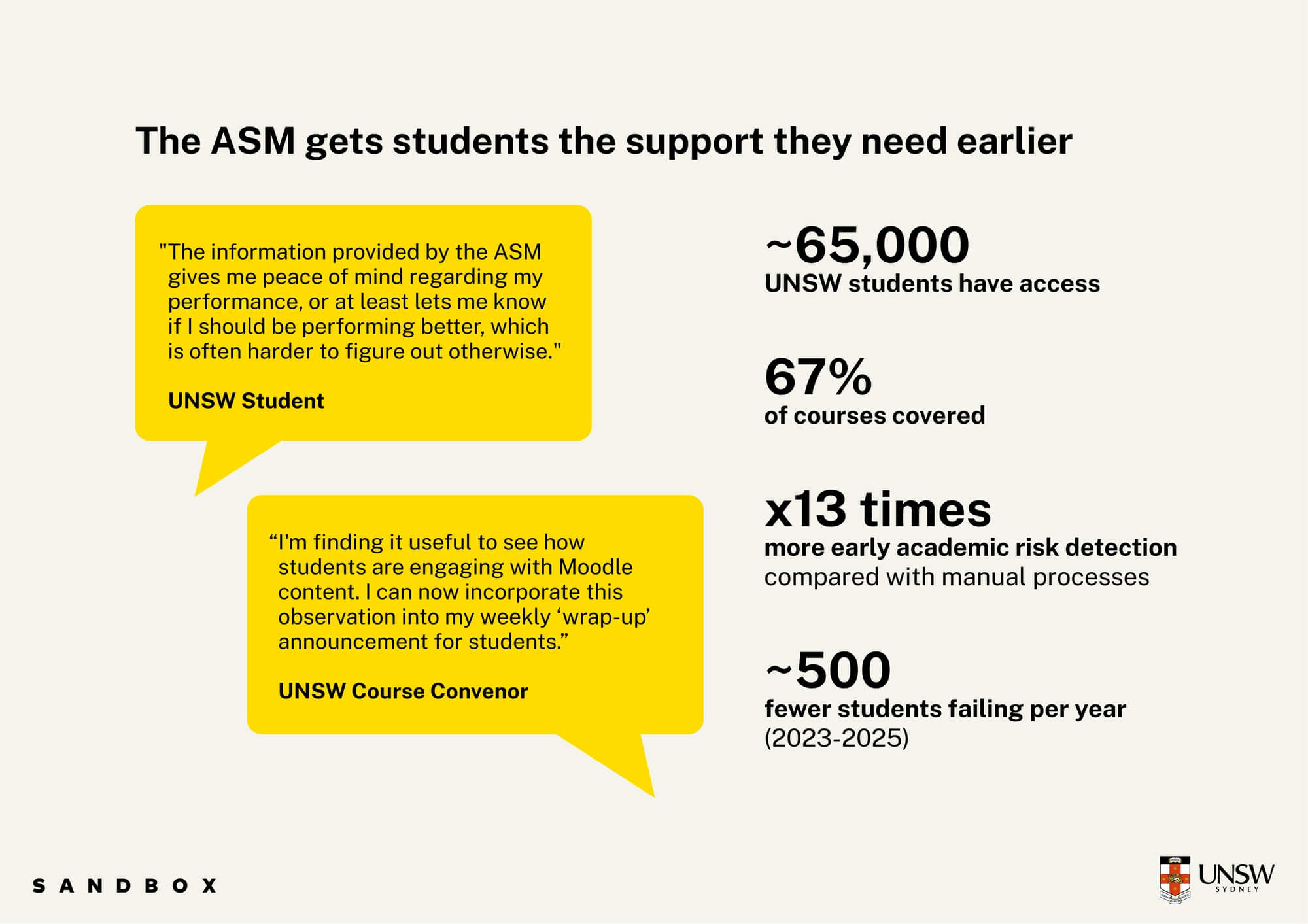
  • Today the Academic Success Monitor supports approximately 65,000 UNSW students (78% of students) and is used across the majority of courses. Courses using ASM show a statistically significant 0.86% reduction in failure rates (2023–2025), equivalent to roughly 500 fewer students failing each year. Students receive earlier, more personalised support, while teaching and support staff get more timely information to help them manage emerging risks. The success of the ASM has shifted how the university approaches AI and analytics, demonstrating how engaging students and staff in the design process can de-risk innovation and build organisational confidence in AI adoption.

  • The service combines predictive analytics, AI outreach and human judgement to enable proactive student support at scale.Predictive academic risk modelThe service leverages previously under-utilised educational data to identify students who may be at risk of academic failure early in the term. By analysing patterns across academic performance, digital engagement and contextual data, the model detects emerging risk signals before problems escalate.AI-generated outreach and support suggestionsWhen risk is detected, the system automatically generates personalised communication to students and staff, and recommends appropriate support pathways. These suggestions connect students with relevant academic, wellbeing or procedural support services, ensuring interventions are timely and targeted.Empathetic AI communicationAutomated messages are purposefully designed to encourage help-seeking and reduce stigma. Codified communication principles ensure outreach uses supportive language, clear guidance and motivational nudges that prompt students to take positive action.Human-in-the-loop oversightAI insights support, rather than replace, human judgement. Both teaching and support staff retain visibility of student risk signals and can intervene directly when more complex or sensitive support is required.Multiple user applicationsThe predictive engine powers different interfaces for students, educators and support teams, translating complex analytics into actionable insights suited to each user group’s distinct needs.