Campaign Website for the National Lung Cancer Screening Program

good-design-award_winner_rgb_blk_logo
  • 2026

  • Digital
    Web Design and Development

Designed By:

Commissioned By:

Cancer Council Victoria

Designed In:

Australia

The NLCSP campaign website is a multilingual, accessible website designed to drive
awareness and participation in the Australian Government’s National Lung Cancer Screening
Program. It delivers clear, audience led content for diverse communities, helping eligible
Australians understand their risk and take action through an engaging digital experience.

view website

2.jpg
3.jpg
4.jpg
5.jpg
6.jpg
  • CHALLENGE
  • SOLUTION
  • IMPACT
  • MORE
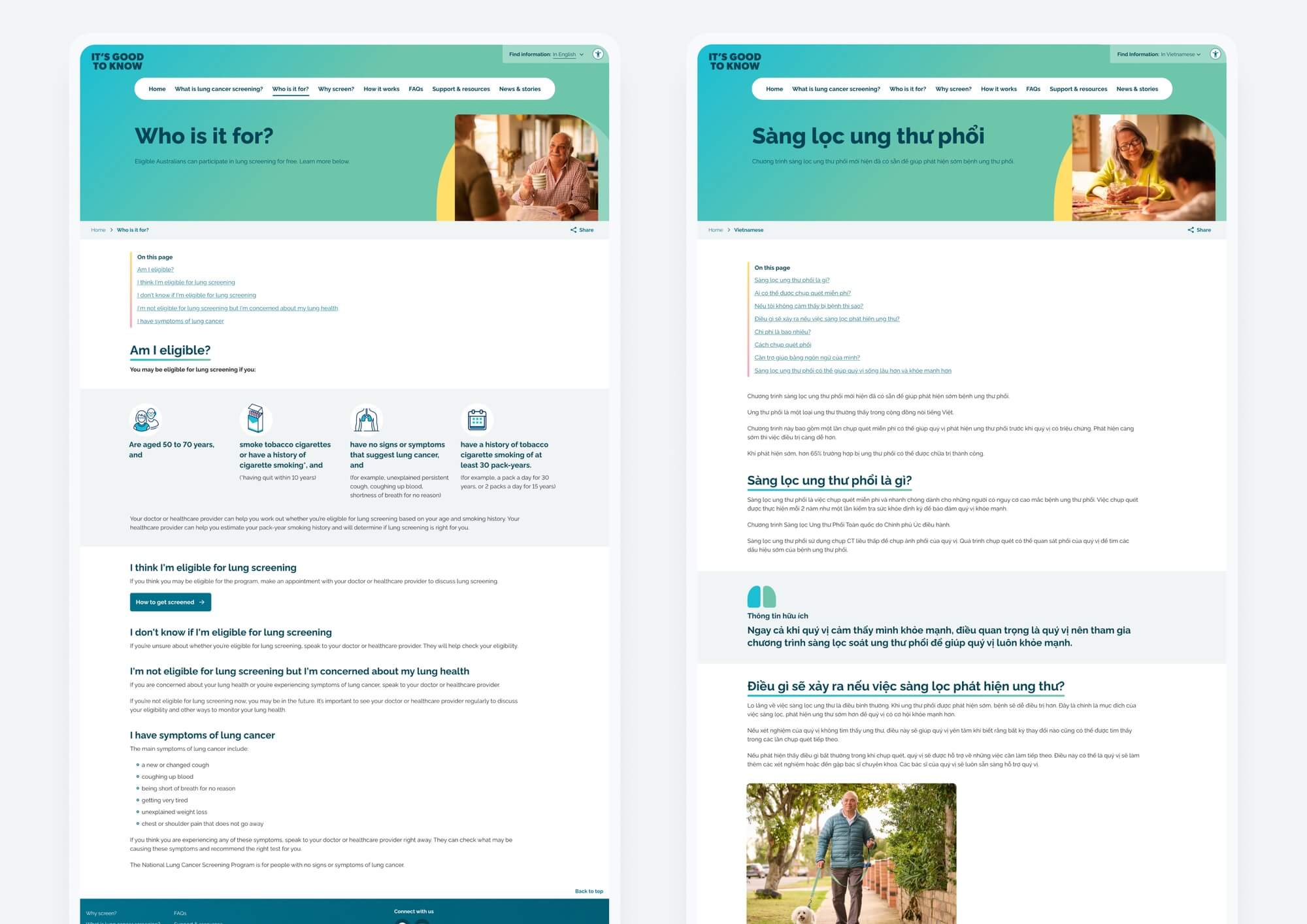
  • The National Lung Cancer Screening Program (NLCSP) launched by the Australian Government on 1 July 2025 required a campaign website to raise awareness of the NLCSP and support participation in the eligible audience. Traditional government websites are typically dense and informational, limiting engagement. The challenge was to create a campaign-led website that simplified complex health information while remaining accessible, culturally relevant and easy to navigate. It needed to support multiple languages and perform in low-connectivity environments. Ensuring cultural relevance and clarity for priority communities, including First Nations and multicultural audiences, was critical to achieving meaningful uptake.

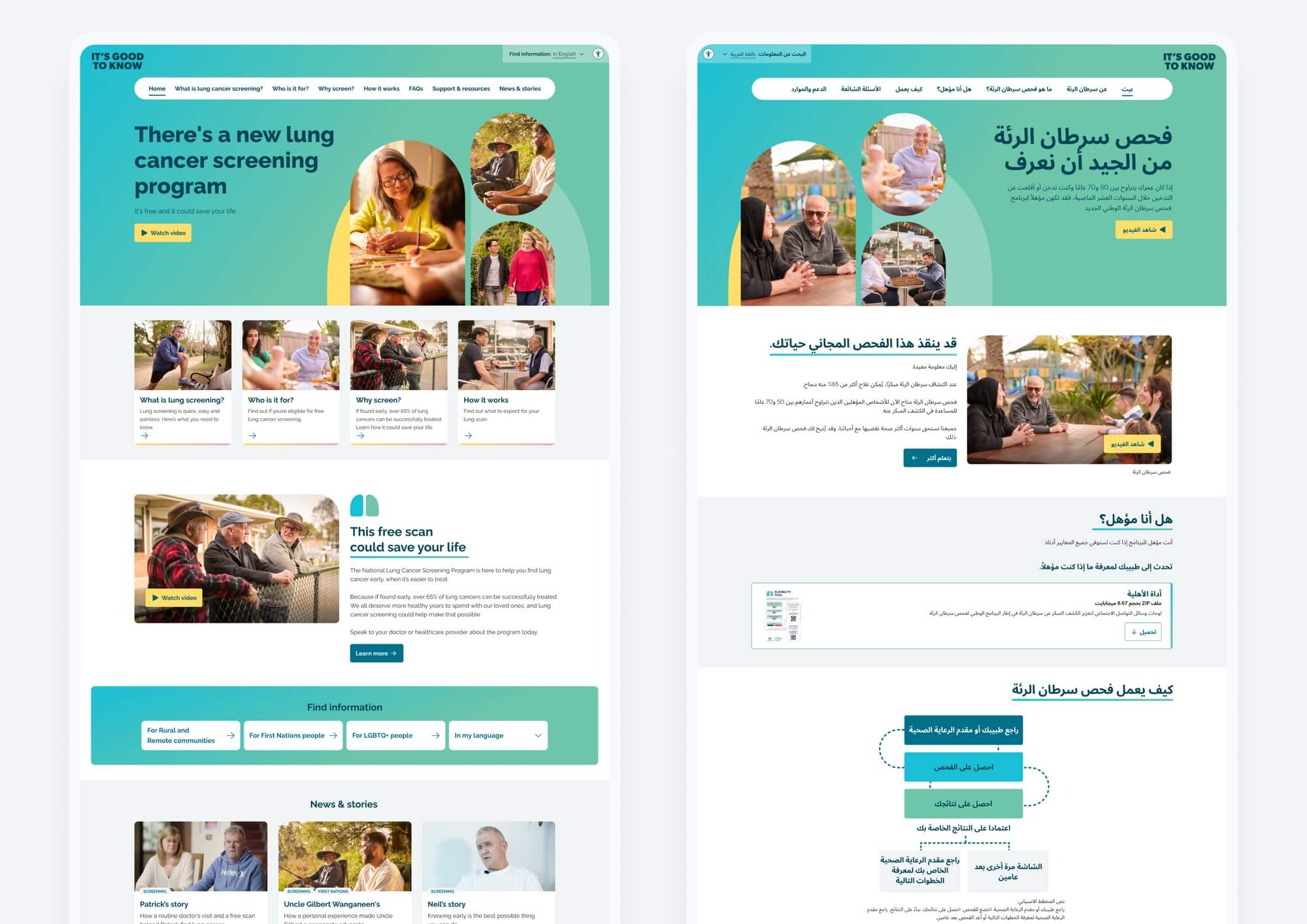
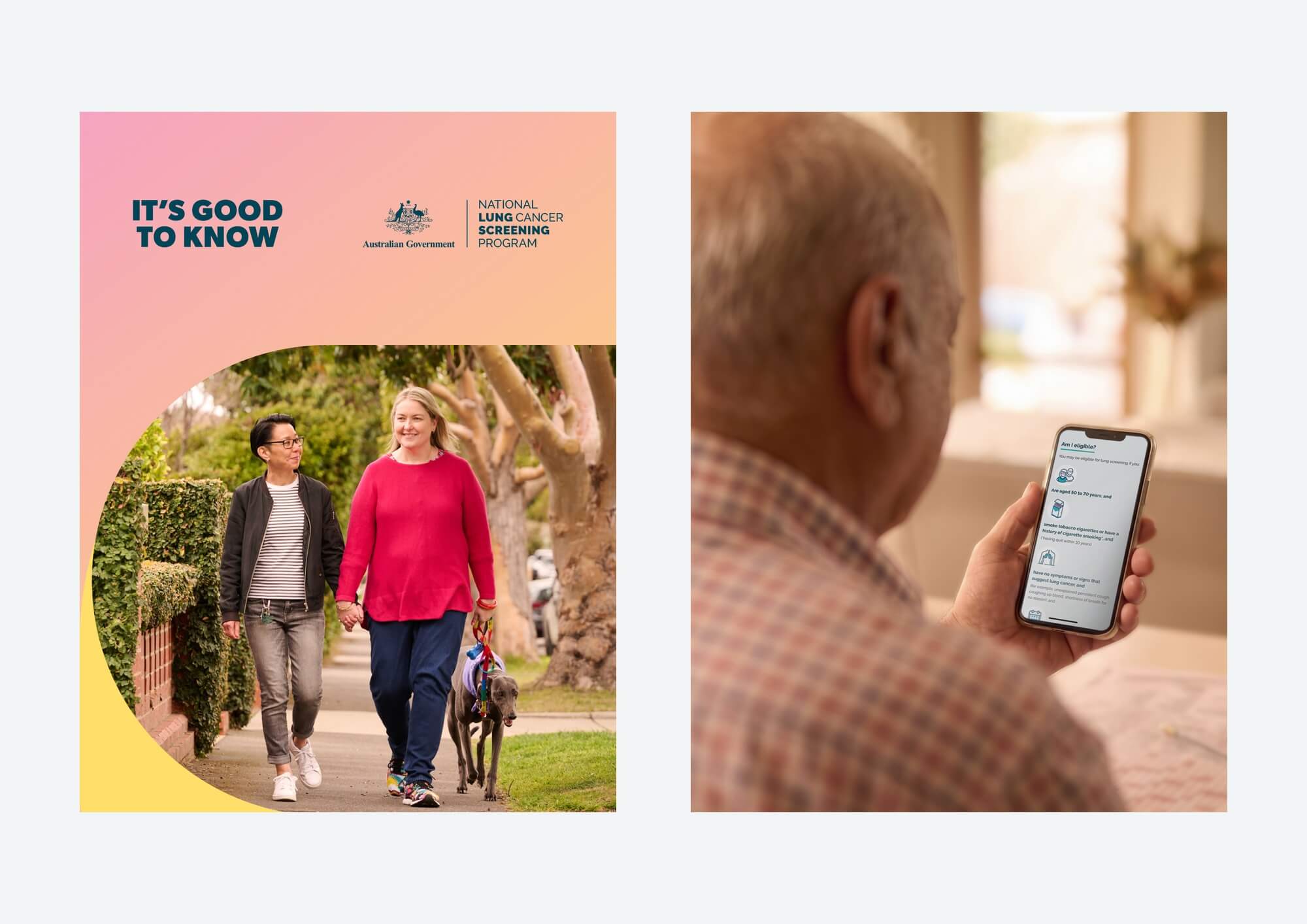
  • The solution is a campaign website designed to prioritise clarity, accessibility and action. A mobile-first, AA accessible solution ensures usability across devices. The experience is structured around audience-specific pathways, with multilingual support including both left-to-right and right-to-left formats. Design and content were shaped through close collaboration with partner organisations and communities, ensuring relevance and cultural sensitivity. A flexible CMS supports ongoing content creation and scalability. Visually, the site moves beyond government convention, using a bold campaign identity and clear hierarchy to break down complex information into simple, actionable steps that guide users toward screening participation.

  • The website has played a key role in supporting the national rollout of lung cancer screening, contributing to more than 60,000 Australians being screened since launch. By simplifying complex health information and tailoring content to diverse audiences, the site improves understanding and encourages early action, directly supporting life saving outcomes. Its accessibility and performance ensure equitable access, particularly for regional communities. The site strengthens campaign effectiveness by providing a high-performing destination for uptake. More broadly, it contributes to increased awareness and early detection, delivering measurable public health impact and reinforcing the value of design in driving meaningful behavioural change.

  • The It’s Good to Know consumer communications campaign is an equity-first campaign that is supported by the Australian Government and has been developed in partnership with a consortium of organisations, including Cancer Council Victoria, the Daffodil Centre, the National Aboriginal Community Controlled Health Organisation, ACON, the Australian Multicultural Health Collaborative and the Royal Flying Doctor Service South Eastern Section to raise awareness of the NLCSP and support participation in the eligible audience. Cancer Council Victoria engaged Northmost on behalf of the Australian Government to develop a new campaign website. A range of features were designed to maximise accessibility, engagement and long-term scalability. A key feature is its multi-site solution, supporting both left-to-right and right-to-left languages. This ensures inclusivity for multicultural audiences and allows the interface to adapt seamlessly to different reading patterns, maintaining a consistent user experience. Landing pages provide tailored content for priority groups, including Aboriginal and Torres Strait Islander peoples, multicultural communities, LGBTQ+ communities, and rural and remote communities. The site is an AA accessible, mobile-first, responsive design ensures optimal performance across devices. A flexible CMS empowers internal teams to create and manage content, ensuring the site can evolve alongside the program.