Listen to Me: Co-Producing Accessible Patient Reported Experience Measures With and For People With Intellectual Disability

good-design-award_gold-winner_rgb_blk_logo

Listen to Me is the first-of-its-kind digitally-enabled Patient Reported Experience Measures (PREMs) co-designed with and for people with intellectual disability. It’s now piloted across healthcare settings in NSW and Victoria, projecting to enable 500,000 Australians living with intellectual disability to have their healthcare experiences captured for system-wide care quality improvement


view website

2.jpg
3.jpg
4.jpg
5.jpg
6.jpg
7.jpg
  • CHALLENGE
  • SOLUTION
  • IMPACT
  • MORE
  • People with intellectual disability experience mortality rates 7–12 times higher than the general population, yet their experiences are largely absent from patient-reported data for healthcare quality improvement. Existing PREMs are unsuitable: surveys of 50–80 items with complex language and no audible or visual supports. Systematic review confirmed no validated PREM existed internationally for system-wide use with this population. The Disability Royal Commission found systemic neglect of people with cognitive disability in Australian healthcare. The challenge was to co-create PREMs that capture what matters for people with intellectual disability, and improve tailored healthcare that remains out of reach for this population.

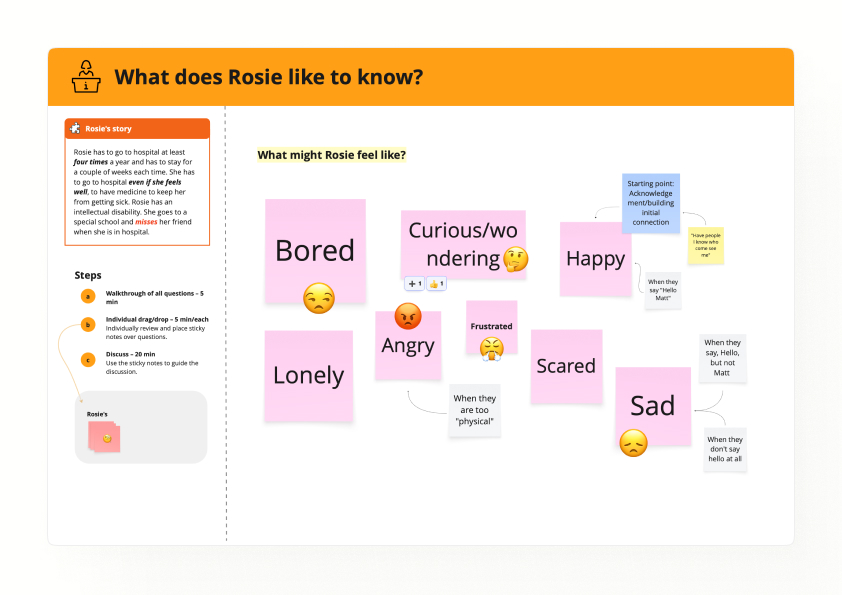
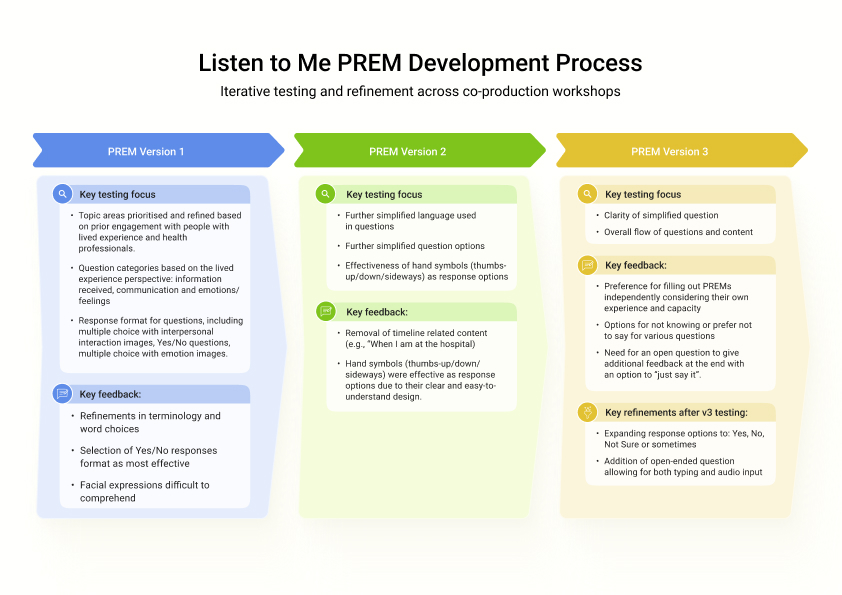
  • The Listen to Me project was led by a Consumer Leadership Group of eight members, including two people with intellectual disability employed as co-researchers, across the whole design process using the Double Diamond framework. Innovative and accessible methods including body storming and empathy mapping with real patient case studies ensured inclusive participation. The interdisciplinary team iteratively developed a 9-item digital PREM with accessible features: large fonts, audible options, simplified language, hand-symbol response options, and visual supports. User testing via think-aloud interviews with 11 people with diverse communication needs refined the prototype through three iterations, producing both inpatient and outpatient versions.

  • The Listen to Me PREMs are piloted across one NSW specialist clinic and a Victorian hospital network (7 hospitals), with 15 consumers completing the tool and further testing underway with children. Diverse settings including dental and mental health clinics have requested use of the tool. Further impact includes two peer-reviewed publications and four conference presentations delivered by two mothers of children with intellectual disability and researchers internationally. The methodology has directly led to a further MRFF-funded program developing ePROMs for this population. Partnerships with ACSQHC, NSW BHI, ACI, and Safer Care Victoria establish a defined pathway for national implementation.

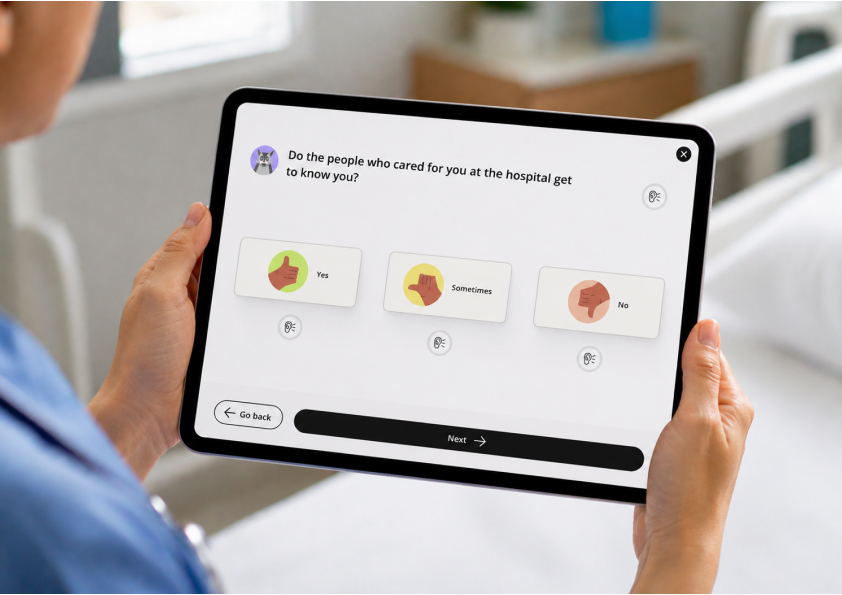
  • Key design features include: completing survey modes (i.e., with or without a support person) selection at the beginning to maximise autonomy; a 9-item survey with large black font and accompanying images for every question; audio playback enabling each question to be read aloud; hand-symbol response options (thumbs up, sideways, and down) chosen over face emojis following user testing with people with intellectual disability who found them clearer and more intuitive; simplified language developed through co-design and co-production with the Consumer Leadership Group; and compatibility across touch-screen devices. The open response item allows typed or audio-recorded answers, enabling people with diverse communication approaches to share experiences in their preferred modality. Both inpatient and outpatient versions were produced to reflect the diversity of care settings. Embedded scoring and database facilitates integration with existing health service data infrastructure and benchmarking alongside general population PREM data. A draft user guide, Easy Read summary, and all PREM resources are available through the Listen to Me project webpage at Macquarie University, supporting open access, transparency, and uptake by health services nationally and internationally.